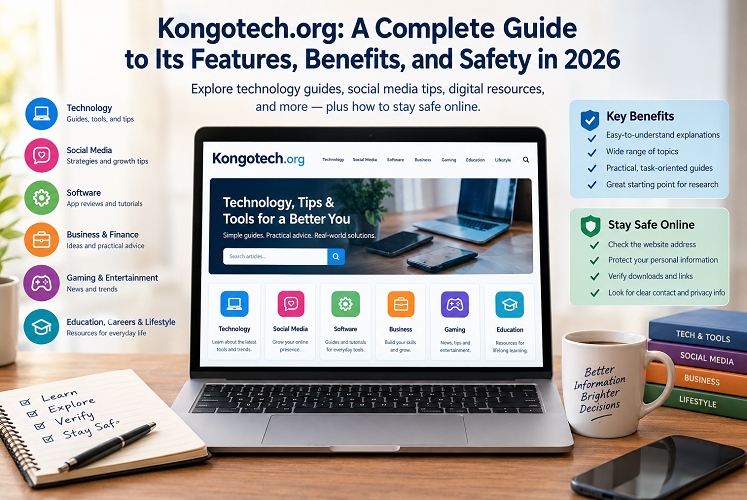
Finding reliable technology information online can be challenging. New websites appear regularly, and each promises to help readers understand digital tools, online services, and emerging trends. Kongotech.org is one name that may attract users looking for technology-related information and practical digital guidance.
But what does Kongotech.org offer? Who might benefit from visiting it, and how can readers decide whether its content deserves their trust?
These questions matter because a website’s name and appearance alone cannot establish its credibility. Readers need to consider the quality of its articles, the transparency of its ownership, the accuracy of its claims, and the safety of its links.
This guide examines Kongotech.org from a practical perspective. It explores the site’s potential uses, the features readers should look for, its possible advantages and limitations, and the steps users can take to protect themselves online.
An important distinction: Website content and features can change over time. Unless independently confirmed, specific tools, services, ownership details, and security claims should not be treated as established facts. Readers should verify the current website directly before relying on its information.
Also Read: Techslassh.com Review
What Is Kongotech.org?
Kongotech.org is a website name associated with technology-orientated online content. People searching for the domain may want to learn about its purpose, the information it publishes, or whether it offers useful resources for everyday digital tasks.
Technology websites generally cover subjects such as software, mobile applications, internet services, digital tools, and consumer technology. Depending on their editorial focus, they may also publish tutorials, troubleshooting advice, product discussions, and explanations of emerging technologies.
However, a site’s name does not confirm that it covers every one of these subjects. Readers should review Kongotech.org itself to determine which topics it currently publishes and whether those pages meet their needs.
The distinction is important. A website can be useful for introductory reading without being an authoritative source for technical decisions, financial matters, or cybersecurity advice.
Before relying on any article, check when it was published, whether it cites credible sources, and whether its recommendations match information from established providers.
What Can Readers Expect From Kongotech.org?
A website’s value depends on the information it actually provides. When evaluating Kongotech.org, readers should focus on its current content rather than assumptions based on its name.
Here are several areas worth examining.
1. Technology Information
Technology publications can help readers understand digital products, online services, and changes in the technology industry.
Clear explanations are particularly useful for people who do not have a technical background. An effective article should explain unfamiliar terms, provide relevant examples, and distinguish established facts from predictions or opinions.
If Kongotech.org publishes technology explainers, assess whether its articles answer the questions they raise. A useful article should offer more than a collection of broad statements or repeated definitions.
2. Software and Application Guidance
Software guides can help readers understand how applications work, compare available options, and troubleshoot common problems.
Good instructions are specific and easy to follow. They should identify the relevant operating system or software version when necessary and explain what users should expect at each step.
Readers should be especially cautious with tutorials that recommend downloading unfamiliar files, installing unofficial applications, or disabling built-in security protections.
Before following a software guide on Kongotech.org, compare its instructions with the application’s official documentation. This extra step can prevent compatibility problems and reduce the risk of installing unsafe software.
3. Internet and Digital Services
Online services are part of everyday life. People use them to communicate, manage accounts, complete work, access information, and handle personal tasks.
Articles about digital services can be helpful when they explain account settings, privacy options, common errors, or changes to a platform’s features.
Accuracy matters in this area. Online services frequently update their interfaces and policies, so older instructions may no longer work. Look for publication dates, recent updates, and links to official support pages.
4. Practical Tutorials
A well-written tutorial turns information into something readers can use.
For example, a useful guide might explain how to adjust a device setting, resolve a common software issue, or improve an account’s security. It should provide clear steps and explain any risks associated with the process.
When reviewing tutorials on Kongotech.org, look for instructions that are complete, current, and appropriate for the intended audience. Avoid following complicated technical commands when the article does not explain what they do.
5. Emerging Technology Topics
Artificial intelligence, cloud computing, mobile technology, and digital security continue to influence how people work and communicate.
Technology websites may help readers understand these developments without requiring advanced technical knowledge. However, emerging technologies also attract exaggerated claims and misleading headlines.
Reliable coverage separates demonstrated capabilities from speculation. It should explain limitations, identify relevant sources, and avoid presenting future possibilities as guaranteed outcomes.
Key Features to Look for on Kongotech.org
The following checklist can help readers assess the website’s usability and editorial quality. These are evaluation criteria, not a claim that every feature is currently available on Kongotech.org.
| Feature to examine | Why it matters |
|---|---|
| Clear navigation | Helps readers find relevant information quickly |
| Organised categories | Makes related articles easier to discover |
| Practical explanations | Helps users apply information to real situations |
| Publication dates | Shows when information was originally published |
| Updated articles | Helps keep instructions relevant as technology changes |
| Credible references | Gives readers a way to verify important claims |
| Mobile-friendly design | Improves readability on phones and tablets |
| Contact information | Helps readers identify a route for questions or corrections |
| Privacy policy | Explains how the website handles personal information |
| Secure browsing | Helps protect information exchanged with the site |
A website does not need every possible feature to be useful. Still, strong navigation, transparent policies, and well-supported articles make it easier for readers to judge its quality.
Benefits of Using Kongotech.org
Whether Kongotech.org is useful to a particular reader depends on its current content and how well that content addresses the reader’s needs. Several potential benefits are worth considering when evaluating a technology resource.
Easier Access to Information
A well-organised technology website can bring related information together in one place. Instead of searching through unrelated pages, readers may be able to find explanations and practical guidance on a particular subject.
This is most useful when articles have descriptive headings, straightforward language, and clear answers to common questions.
Help for Beginners
Technical subjects can feel intimidating when explanations rely on unfamiliar terminology.
Content written for beginners can make digital topics easier to understand. Definitions, examples, and step-by-step instructions help readers build confidence before moving on to more advanced material.
Readers should still check important claims against primary sources, particularly when an article concerns privacy, cybersecurity, or device settings.
Support for Everyday Troubleshooting
People often search online when something stops working. A clear troubleshooting guide may help them identify a problem, understand its likely cause, and choose a sensible next step.
The best guides explain both what to do and why the recommended action may help. They also identify situations that require professional support or official customer service.
Convenient Learning
Online articles allow readers to learn at their own pace. They can revisit an explanation, compare recommendations, and explore related topics whenever they have time.
This flexibility can be useful for students, professionals, and everyday technology users. The quality of the learning experience, however, depends on the accuracy and clarity of the material.
Discovering Useful Digital Resources
Technology websites sometimes introduce readers to applications, online tools, and services they might not otherwise encounter.
Discovery can be valuable, but recommendations deserve scrutiny. Readers should understand whether a recommendation is editorial, sponsored, or affiliated with a commercial partner. They should also confirm that a suggested tool comes from a legitimate provider.
Is Kongotech.org Safe to Use?
Safety should be assessed separately from content quality. A website might publish useful articles yet still contain questionable links, intrusive advertising, or unclear privacy practices. Conversely, a professional-looking design does not prove that a site is trustworthy.
Without a current, independent assessment of Kongotech.org, it would be inappropriate to declare the website completely safe or unsafe. Users can make a more informed decision by checking several indicators.
Check the Website Address
Confirm that the address is spelt correctly and that the browser is displaying the intended domain.
Look carefully for extra words, misspellings, or unusual extensions in links that claim to lead to the website. Fraudulent pages sometimes imitate familiar names to mislead visitors.
HTTPS encryption is useful because it protects data in transit, but it does not prove that a website’s owner is honest or that its content is accurate.
Review Privacy and Contact Information
A credible website should make its privacy practices reasonably clear. Look for a privacy policy that explains what information may be collected, how it is used, and whether it is shared with other parties.
Contact details and information about the site’s publisher can also help readers assess accountability. Missing information does not automatically prove wrongdoing, but a lack of transparency is a reason to be cautious.
Be Careful With Downloads
Do not download unfamiliar files simply because an article recommends them.
When software is needed, use the developer’s official website or a recognized application store whenever possible. Check the publisher, file details, permissions, and available security warnings before installing anything.
Avoid instructions that require you to turn off antivirus protection, bypass browser warnings, or run unexplained commands.
Avoid Sharing Sensitive Information
A general technology article should not require your password, banking PIN, one-time verification code, or other confidential credentials.
Never enter sensitive information unless you understand why it is needed and have independently verified the service requesting it. Be particularly careful with forms that promise prizes, free subscriptions, account recovery, or unusually attractive offers.
Watch for Misleading Claims
Be skeptical of articles that promise guaranteed earnings, instant technical fixes, unrestricted access to paid services, or exceptional results without credible evidence.
Check the claims against official documentation and reputable independent sources. If a recommendation could affect your finances, privacy, or device security, take time to verify it before acting.
How to Evaluate Information Published on Kongotech.org
A website’s reliability comes down to more than presentation. The following process can help readers decide whether an article is worth using.
Step 1: Identify the Author or Publisher
Look for an author name, an editorial team, or information about the organization responsible for the content.
Author details are not proof of expertise on their own, but relevant experience and a transparent publishing process can help readers judge credibility.
Step 2: Check the Publication and Update Dates
Technology changes quickly. An article about an application, operating system, or online service may become outdated after a major update.
Check whether the article has a publication date and whether its instructions match the current version of the product or service.
Step 3: Follow the Sources
Reliable articles should provide evidence for important factual claims.
When an article makes a specific claim about a product, security issue, policy, or technical feature, look for links to official documentation, research, or other reputable reporting. Follow those links instead of relying solely on the article’s summary.
Step 4: Compare Important Information
Cross-check consequential claims with at least one trustworthy source. For software instructions, the developer’s official support documentation is often a good starting point.
For cybersecurity topics, prioritize established security organizations and official advisories. For product specifications, consult the manufacturer’s published information.
Step 5: Examine the Website Experience
Notice whether the site uses excessive pop-ups, deceptive download buttons, unexpected redirects, or repeated prompts to provide personal information.
These behaviors do not establish the site’s overall reputation by themselves, but they can signal that a closer review is warranted.
Step 6: Decide Whether the Article Meets Your Needs
A brief introductory article may be sufficient for general background. A more consequential decision requires stronger evidence.
For example, choosing a new wallpaper application may involve limited risk. Installing software with extensive device permissions or changing account-security settings requires more careful verification.
Use the level of scrutiny that matches the potential consequences.
Kongotech.org Compared With Other Technology Websites
Readers have many ways to find technology information, including independent blogs, official support pages, specialist publications, and established technology news outlets.
Each source serves a different purpose. The right choice depends on the question being asked.
| Source type | Main strength | Main limitation |
|---|---|---|
| Independent technology websites | May offer accessible explanations and practical tips | Quality and editorial standards vary |
| Official product documentation | Provides information from the product’s developer | May use technical language or focus narrowly on one product |
| Established technology publications | Often provide reporting, product analysis, and industry context | Some content may require a subscription |
| Community forums | Offer firsthand experiences and troubleshooting ideas | Advice may be incomplete, outdated, or incorrect |
| Video tutorials | Demonstrate procedures visually | Videos can become outdated and may omit important details |
Kongotech.org should be assessed using the same standards as other independent technology websites. Compare the relevant article with a primary source and consider whether it provides enough evidence, context, and practical detail.
No single source is ideal for every question. Combining accessible explanations with official documentation is often a stronger approach than relying on one website alone.
Pros and Cons of Using Kongotech.org
The advantages and limitations of a technology website depend on its actual content, transparency, and maintenance. The following points describe what readers should weigh when deciding whether to use Kongotech.org.
Potential Advantages
- Convenience: A focused website may make technology information easier to find.
- Accessible explanations: Beginner-friendly writing can help readers understand unfamiliar topics.
- Practical guidance: Clear tutorials may help with common digital tasks.
- Flexible learning: Online content can be revisited whenever needed.
- Topic discovery: Readers may find new tools or subjects worth exploring.
These advantages apply only when the site provides relevant, accurate, and well-maintained material.
Potential Limitations
- Uncertain content quality: Articles should be evaluated individually rather than accepted at face value.
- Outdated instructions: Software and online services change frequently.
- Limited transparency: Readers may need to investigate the publisher and its editorial practices.
- Unverified recommendations: Suggested tools and services require independent checks.
- Potential security concerns: Unfamiliar downloads, misleading links, or intrusive prompts should be treated cautiously.
The key is to judge the website by evidence rather than assumptions. A useful article can still require verification, and an attractive design is no substitute for accuracy.
Who Might Benefit From Kongotech.org?
If its current content matches their interests, several types of readers may find a technology website like Kongotech.org useful.
Beginners
People who are still learning how to use digital devices may appreciate plain-language explanations and carefully structured instructions.
Students
Students researching technology concepts may use introductory articles to understand a topic before consulting textbooks, academic materials, or official documentation.
Everyday Technology Users
Readers who want to learn more about applications, online services, or common device problems may benefit from practical guides.
Professionals
Workers who regularly use digital tools may find concise explanations useful when exploring unfamiliar features or resolving minor technical issues.
However, professionals should verify information before using it in business-critical systems or making decisions involving confidential data.
Curious Technology Readers
People who enjoy learning about new products and digital developments may use technology websites to discover subjects for further research.
For all these audiences, the same principle applies: use online articles as a starting point, then verify important information through appropriate sources.
Tips for Getting More Value From Kongotech.org
If you decide to explore the website, a few habits can improve your experience and reduce unnecessary risk.
- Start with a specific question. Knowing what you want to learn makes it easier to judge whether an article is relevant.
- Read beyond the headline. Headlines may simplify or exaggerate a subject. Check the article’s details and supporting evidence.
- Look for current information. Pay attention to dates, software versions, and references to recent changes.
- Verify important claims. Use official documentation or credible independent sources for consequential decisions.
- Avoid suspicious downloads. Do not install files from unknown sources or follow instructions that weaken security protections.
- Protect your personal information. Avoid sharing credentials or sensitive details without a clear, legitimate reason.
- Use multiple sources. Comparing explanations can reveal missing context, conflicting claims, or outdated advice.
- Report or avoid questionable content. If an article appears misleading or a link behaves suspiciously, stop and investigate before proceeding.
These habits are useful across the internet, not just on one domain. They help readers distinguish convenient information from advice that deserves closer scrutiny.
(FAQs): About Kongotech.org
1. What is Kongotech.org?
Kongotech.org is a website that people may encounter while searching for technology-related information. To understand its current purpose, readers should visit the domain and review its available pages rather than assume a particular set of features or services.
2. What does Kongotech.org offer?
Its current offerings should be confirmed directly on the website. Look for its published topics, tutorials, resources, and any tools or services it explicitly describes. Do not assume that a feature exists unless the site provides evidence of it.
3. Is Kongotech.org safe?
Its safety cannot be confirmed from the domain name alone. Check the address, privacy policy, contact information, links, and any download requests. Use browser protections and security software, and avoid sharing sensitive information with an unfamiliar service.
4. Is Kongotech.org free to use?
Whether the website charges for access, offers paid services, or includes restricted content should be verified on its current pages. Review any pricing terms before registering, subscribing, or entering payment information.
5. Does Kongotech.org provide reliable technology information?
Reliability depends on the individual article and the evidence behind its claims. Look for credible references, relevant author information, current publication dates, and consistency with official documentation.
6. Can beginners use Kongotech.org?
Beginners may find a technology website helpful if its articles use clear language and explain technical concepts carefully. Before following instructions, check that the content is current and that the recommended actions are appropriate for your device or software.
7. Does Kongotech.org offer software downloads?
Do not assume that downloads are available without checking the website. If it recommends software, verify the publisher and obtain the file from the developer’s official source whenever possible.
8. Can I trust recommendations published on Kongotech.org?
Treat recommendations as information to evaluate, not instructions to follow automatically. Check supporting evidence, identify possible commercial relationships, and compare important claims with independent sources.
9. What should I do if Kongotech.org asks for personal information?
First, determine why the information is being requested and whether it is necessary. Review the privacy policy and confirm that you are using the intended website. Never provide passwords, banking PINs, or one-time verification codes in response to an unexpected request.
Conclusion
Kongotech.org may be worth exploring for readers looking for technology-related information, but its value depends on what the website currently publishes and how reliably it supports its claims.
A careful evaluation should consider content accuracy, author transparency, publication dates, privacy practices, and the safety of links or downloads. These checks are more useful than relying on a domain name or a professional-looking design.
For everyday learning, an accessible technology article can be a convenient starting point. For software installation, cybersecurity, financial decisions, or other high-impact matters, verify the information through official documentation and reputable independent sources.
Ultimately, the best way to evaluate Kongotech.org is to examine its actual content, confirm important claims, and use sensible online safety practices. That approach helps readers make informed decisions while avoiding unnecessary risks.